

How to Build Mandarin Speaking Confidence: A Practical Guide for 2026

Updated: Jul 15
Imagine standing at a bustling street food stall while your heart races and your mind goes completely blank. You've studied the vocabulary for months, yet the moment you need to order, a thick "brain fog" sets in. This paralyzing experience is the biggest hurdle to building mandarin speaking confidence, and it often stems from a deep fear of getting your tones wrong or sounding like a rigid robot. We know exactly how it feels to have the words stuck in your throat while everyone waits for you to speak.
It's time to stop letting anxiety dictate your progress. This guide provides actionable strategies to help you overcome language nerves and speak Mandarin Chinese naturally, even if the thought of making a mistake currently terrifies you. You'll learn how to transition from formal, stuttered phrases to a genuine sense of flow. We're going to explore how to develop the muscle memory for authentic pronunciation and use "performance-free" practice to make ordering food or holding basic conversations feel like second nature.
Table of Contents
The Psychology of Mandarin Speaking Confidence: Reframing Mistakes
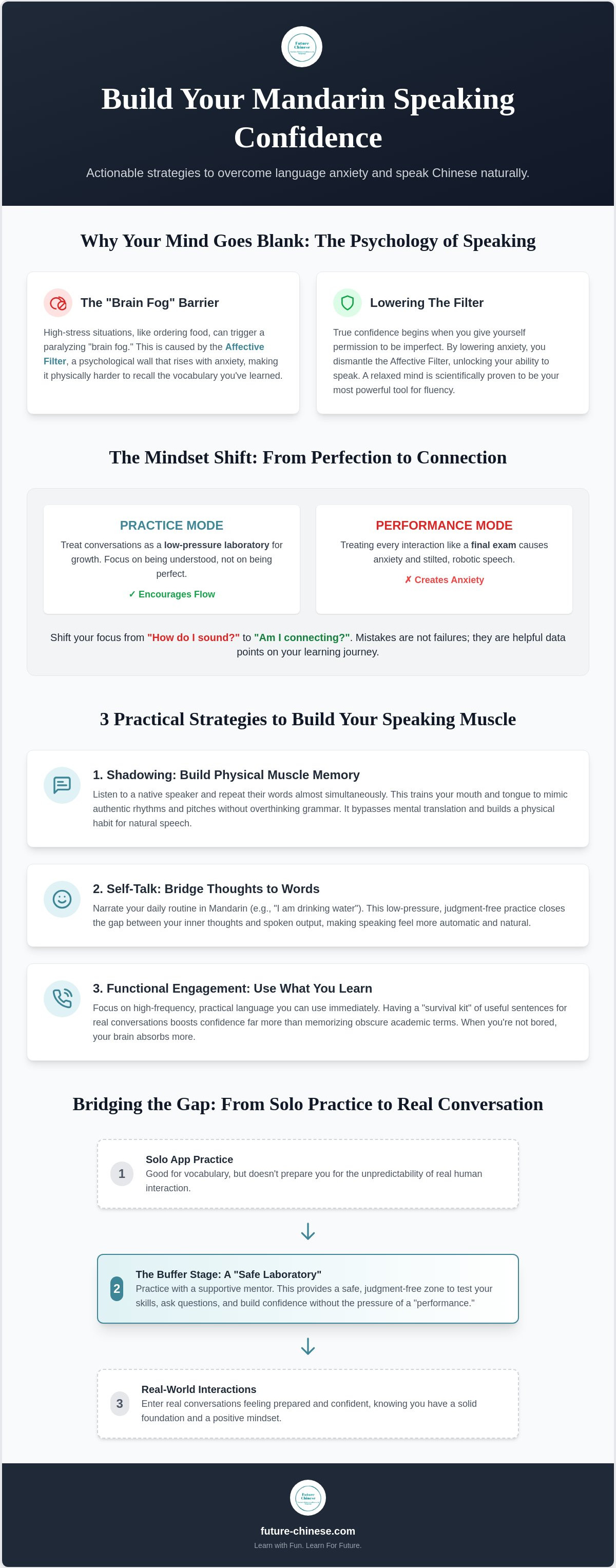
True confidence isn't the absence of errors; it's the presence of freedom. Many learners believe they'll finally feel brave once they master every grammar rule, but mandarin speaking confidence actually begins the moment you give yourself permission to be imperfect. When you're gripped by anxiety, your brain activates what researchers call the "Affective Filter." This psychological wall rises during high-stress moments, making it physically harder to recall the words you know. Understanding The Psychology of Language Learning reveals that a relaxed mind is your most powerful tool for fluency.
To break through, you must distinguish between "Practice Mode" and "Performance Mode." Most students treat every interaction like a final exam, but growth happens when you treat conversation as a low-pressure laboratory. We define Mandarin confidence as a communication-first mindset that accepts linguistic slips as helpful data points rather than personal failures. It's about prioritizing the connection with your conversation partner over the precision of your syntax. When you shift your focus from "How do I look?" to "Am I being understood?", the heavy weight of expectation begins to lift.
Overcoming 'Tone Terror' and the Fear of Being Misunderstood
Do you worry that one wrong pitch will change your entire meaning? It's time to reframe tones as the "melody" of your speech rather than a series of individual traps. Native speakers are remarkably good at using context to understand you, even if your tones aren't pitch-perfect. To build your mandarin speaking confidence, try recording yourself on your phone and listening back. This simple habit helps you get used to your own voice and helps you realize that you sound much more capable than your inner critic suggests.
This process of vocal discovery is similar to the training at Vocal Basics, where individuals learn to master their voice to communicate with clarity and confidence, whether through song or speech.
Why Perfectionism is the Enemy of Fluency
If you find yourself "over-monitoring" your grammar mid-sentence, you'll likely end up with a robotic, stilted speech pattern. This habit stops the natural flow of communication and makes the interaction feel like a chore. Instead of aiming for a perfect sentence, try using natural fillers like 那个 (nèige) to bridge the gaps. These small linguistic cushions give your brain time to process while keeping the rhythm of the conversation alive. In our 1-on-1 Customized Lessons, we encourage this "messy" but natural progress, providing a safe laboratory where you can test your voice without judgment.
3 Practical Strategies to Build Your Speaking Muscle
Building mandarin speaking confidence is much like training for a marathon. You wouldn't just read about running; you'd hit the pavement. To speak naturally, you must engage your physical "speaking muscles." Shadowing is a powerful technique where you listen to a native speaker and repeat their words almost simultaneously. This process trains your tongue and mouth to mimic authentic rhythms and pitches without overthinking the grammar. It's about developing a physical habit that bypasses the need for constant mental translation. As speech and semantic technologies evolve, companies like Ubestream Inc. are leading the way in developing sophisticated algorithms that can assist in analyzing and perfecting these natural speech rhythms.
While shadowing handles the physical side, "Self-Talk" masters the mental transition. Try narrating your morning routine in Mandarin. Simple phrases like "I am drinking water" or "The sun is bright" help bridge the gap between your inner thoughts and spoken output. This consistent practice builds the "grit" mentioned in research from Oxford University, which highlights how personal control over your learning environment leads to better retention. When you talk to yourself, there's no audience and no judgment, just pure practice.
Engagement is the final piece of the puzzle. If you're bored, your brain simply stops absorbing information. This is why we prioritize interactive mandarin lessons that focus on high-frequency, functional language you can use immediately. Instead of memorizing obscure academic terms, start with the phrases that help you navigate a real conversation today. You'll find that having a practical "survival kit" of sentences does wonders for your mandarin speaking confidence.
Using Thematic Anchors to Lower Anxiety
It's often easier to speak when your brain is busy doing something else. Thematic anchors, such as our "Little Scientist" activities, provide a creative lens that distracts you from the fear of making mistakes. When you're focused on a science experiment or a character's journey, the language flows as a tool for discovery rather than a subject of scrutiny. This low-pressure engagement allows you to absorb grammar and vocabulary subconsciously while you explore the world.
The Power of Visual Cues and Hanzi Transformation
Recalling vocabulary mid-conversation can be stressful. Our "Hanzi Transformation" approach connects characters to vivid visual stories, making them much easier to "see" in your mind while you speak. You can even try using your own home as a memory palace. Associate specific rooms with different topics to create mental flashcards that trigger speech naturally. If you're looking for a supportive environment to test these techniques, our 1-on-1 Customized Lessons provide a safe space to grow without judgment.
Bridging the Gap: From Solo Practice to Real Conversations
The leap from tapping a screen to talking to a native speaker is often the steepest part of the journey. Apps are fantastic for building vocabulary, but they lack the unpredictable rhythm and emotional weight of human interaction. Without a "buffer" stage, this sudden transition can shatter your hard-earned mandarin speaking confidence. This is where a supportive mentor acts as a vital bridge. They provide a "safe laboratory" where you can experiment with sounds and sentence structures without the social pressure of a public setting.
A study on psychological anxiety confirms that self-efficacy is directly linked to language achievement. When you feel capable, your brain actually performs better. To build this sense of capability, try setting micro-goals for your real-world interactions. Instead of trying to hold a complex debate, aim to simply say "hello" and "thank you" at a local market or restaurant. These small wins accumulate, proving to your brain that you can survive and thrive in Mandarin. For those who want a structured path to these wins, enrolling in a mandarin speaking course is the most efficient way to turn these small steps into a solid foundation of fluency.
The Advantage of 1-on-1 Personalized Guidance
A private tutor does more than just teach grammar; they act as a supportive mirror. They can identify specific "confidence killers" in your speech, such as a recurring tone error that makes you hesitate, and correct them with gentle, constructive feedback. Because our 1-on-1 Customized Lessons are tailored to your interests, you'll spend your energy discussing topics you actually care about. This relevance ensures that your mandarin speaking confidence grows through genuine connection rather than rote memorization.
Finding Your Voice in a Global Community
You don't have to walk this path alone. Joining online communities allows you to practice in a judgment-free zone with peers who share your goals. It's helpful to remember that every fluent speaker once felt the same "brain fog" you might be experiencing now. By surrounding yourself with a supportive network, you'll realize that mistakes aren't roadblocks. They are simply the necessary footsteps on your path to becoming a natural, confident Mandarin speaker.
Transform Your Mandarin Journey with Real Conversation
Building your mandarin speaking confidence is a journey of small, consistent victories rather than a quest for overnight perfection. You've learned that reframing mistakes as valuable data points and training your physical muscle memory through shadowing are the keys to unlocking natural speech. By moving away from the high-pressure "performance mode" that causes brain fog and embracing a communication-first mindset, you can finally bridge the gap between solo study and real-world connection. Every fluent speaker you admire started exactly where you are, and they achieved success by simply refusing to let the fear of being misunderstood stop them.
The path to fluency doesn't have to be a lonely or stressful experience. At Future Chinese, we provide personalized 1-on-1 instruction and low-pressure thematic learning modules designed to make you feel at home with the language from day one. Our warm, expert mentors are dedicated to your growth; they act as the supportive partners you need to turn every stumble into a confident step forward. Are you ready to stop overthinking and start talking? Book your free 1-on-1 trial lesson with Future Chinese and start speaking with confidence today! We look forward to helping you discover the joy of effortless conversation.
Frequently Asked Questions
How long does it take to feel confident speaking Mandarin?
You can start feeling a significant shift in your mandarin speaking confidence within 3 to 6 months of consistent, active practice. While full fluency is a longer journey, the ability to handle basic daily tasks like ordering food or introducing yourself comes much sooner. It’s all about shifting your focus from grammatical perfection to functional progress. Regular sessions with a supportive mentor can help you reach this level of comfort even faster.
Will people laugh at me if I get my tones wrong?
It’s highly unlikely that people will laugh at you for tone mistakes. Most native speakers are incredibly appreciative of the effort you’re making to learn their language and will naturally use context to understand your meaning. They see tones as a melody; even if a few notes are slightly off, the song is still recognizable. Focus on the connection rather than the pitch, and you’ll find that most listeners are your biggest cheerleaders.
Is it better to focus on speaking or reading first?
Focusing on speaking first is generally more effective if your goal is real-world communication. While reading characters is a valuable skill, speaking builds the immediate feedback loop required for mandarin speaking confidence. By prioritizing your voice, you develop the muscle memory and listening skills that make social interactions feel natural. Reading can then be introduced to reinforce the vocabulary you’ve already learned to use in conversation.
Can I build speaking confidence by just watching movies?
Watching movies is excellent for listening, but it won’t build speaking confidence on its own because it’s a passive activity. To see real results, you must use techniques like shadowing where you repeat the dialogue out loud. This turns a passive hobby into an active workout for your speaking muscles. Without this physical output, your brain won't develop the muscle memory needed to produce the language yourself during real-time conversations.


Comments