

Intermediate Mandarin Vocabulary: Your Strategic Path to Fluency in 2026
- Future Chinese
- Jul 16
- 7 min read

What if the reason you're feeling stuck isn't a lack of effort, but simply that the goalposts have moved? With the full rollout of the HSK 3.0 standards in 2026, the total vocabulary requirement for the intermediate stages has expanded significantly, demanding a much more strategic approach than before. It’s a common frustration to feel like you’re trapped on an "intermediate plateau," where you can handle daily survival tasks but sound robotic the moment a conversation turns to abstract ideas or professional opinions. You've likely felt that sting of forgetting a word just as it’s on the tip of your tongue, or the hesitation that comes with not knowing if a phrase is too formal for the occasion.
In this guide, we’ll help you master the intermediate mandarin vocabulary necessary to move beyond simple exchanges and start speaking with genuine nuance and cultural depth. You’ll learn how to navigate the new HSK 4-6 requirements, understand the hidden meanings behind complex terms, and discover a personalized path to making these words a natural part of your active vocabulary. By the end, you’ll have a clear roadmap to transition from a passive listener to a confident, fluent communicator who can express complex thoughts with ease.
Table of Contents
The Intermediate Vocabulary Plateau: Why Rote Memorization Fails
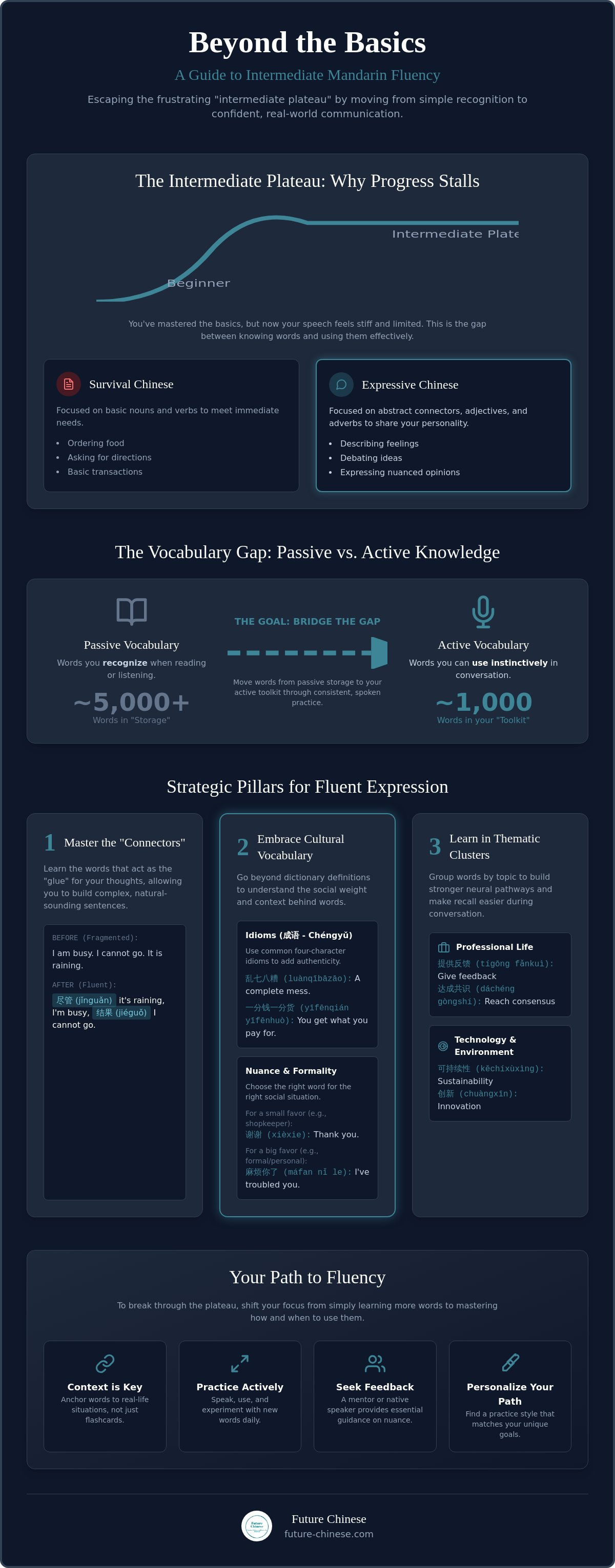
Have you ever felt like your progress just stopped? You've passed the beginner stages, but your speech still feels stiff and limited. This is the intermediate plateau. It's the frustrating gap where your brain recognizes thousands of characters, but your tongue gets tied in a real conversation. While the Chinese Proficiency Test (HSK) provides a useful framework, relying solely on HSK 3 or 4 word lists won't make you fluent. These lists are merely the starting point for a much larger journey. To truly master intermediate mandarin vocabulary, you need to move beyond isolated flashcards and build "contextual anchors" that link words to real-life situations.
Think of your learning journey as a transition from survival to expression. You're no longer just trying to get by; you're trying to be yourself. This shift requires a different strategy:
Survival Chinese: Focused on nouns and basic verbs to meet immediate physical needs, like ordering food or finding a bathroom.
Expressive Chinese: Focused on adjectives, adverbs, and abstract connectors that allow you to describe feelings, debate ideas, and share your personality.
When you learn through rote memorization, you lack the emotional connection to the language that triggers recall during high-pressure moments. Without a story or a specific memory attached to a word, it simply won't stick when you need it most.
Passive vs. Active Vocabulary
There's a massive difference between recognizing a word in a textbook and deploying it during a fast-paced discussion. Passive vocabulary lives in the back of your mind, but active vocabulary consists of the words you can deploy instinctively during live conversation. If you don't practice active recall, your intermediate mandarin vocabulary will remain a collection of "silent" words that you understand but never actually speak. Bridging this gap requires moving words from your "storage" into your "daily toolkit" through consistent, spoken practice.
The Role of Cultural Nuance
At the intermediate level, words carry social weight. Saying "thank you" (xièxie) might be fine for a shopkeeper, but it's often too simple for a formal business setting or a deep personal favor where "I've troubled you" (máfan nǐ le) might be more appropriate. These hidden social hierarchies dictate word choice in ways a dictionary can't explain. Discovering these rules is much easier when you're learning Mandarin online with a native speaker who can explain the "why" behind the "what." This guidance turns a robotic list into a living, breathing tool for genuine human connection.
Core Vocabulary Themes for Real-World Intermediate Fluency
To reach true fluency, you must move beyond the basics and focus on specific themes that mirror adult life. Mastering intermediate mandarin vocabulary involves more than just adding nouns to your list; it's about learning the "connectors" that act as the glue for your thoughts. Words like 结果 (jiéguǒ - as a result) or 尽管 (jǐnguǎn - despite) allow you to build complex sentences that sound natural rather than fragmented. Academic frameworks, such as the University of Georgia's intermediate Chinese curriculum, often emphasize these thematic shifts to ensure students can handle complex social interactions and professional settings.
You also need to cross the "idiom threshold." While beginners avoid Chengyu, intermediate learners should embrace common four-character idioms that appear in daily life. For example, using 乱七八糟 (luànqībāzāo) to describe a messy situation or 一分钱一分货 (yīfēnqián yīfēnhuò) when discussing quality versus price adds immediate authenticity to your speech. In professional circles, focusing on workplace dynamics like "giving feedback" (提供反馈 - tígōng fǎnkuì) or "reaching a consensus" (达成共识 - dáchéng gòngshí) will give you the confidence to participate in meetings without hesitation.
The Power of Topic-Based Clusters
Learning words in isolation is slow and inefficient. Instead, try grouping your intermediate mandarin vocabulary into clusters like "Technology and the Environment." When you learn words like "sustainability" (可持续性 - kěchíxùxìng) alongside "innovation" (创新 - chuàngxīn), your brain forms stronger neural pathways. Our intermediate mandarin course leverages these thematic units to help you build deep word associations, making it easier to recall the right term during a live discussion.
Mastering Nuance: Choosing the Right Word
At this level, you'll encounter many synonyms that have subtle differences. Take 了解 (liǎojiě) and 理解 (lǐjiě). While both mean "to understand," 了解 is often used for being familiar with facts or a person, whereas 理解 implies a deeper, more empathetic understanding of a reason or logic. To see these words in action, try consuming authentic materials like podcasts or news reports. If you're looking for a way to practice these distinctions in real-time, our Adult Mandarin Course offers the perfect environment to refine your usage with expert guidance.
Internalising Your Word Bank: Choosing the Right Study Method
Choosing the right study method is the final piece of the puzzle. While self-study apps are excellent for passive recognition, they often lack the depth needed for true production. Group classes offer social interaction, but you might spend more time listening to others than speaking yourself. This is where 1-on-1 tutoring shines. It creates a "feedback loop" where a mentor corrects your word usage in real-time, ensuring you don't just learn intermediate mandarin vocabulary, but actually use it correctly. This immediate correction prevents bad habits from taking root and builds the professional confidence you need for real-world interactions.
Consistency beats intensity every time. Instead of cramming for hours once a week, try to integrate new words into your daily routine. You can narrate your morning commute in your head or try to write a short journal entry using the themes you've studied. Setting realistic milestones is key to avoiding burnout. Aim for a manageable goal, such as mastering 10 new words a week for passive recognition, gradually working toward a target of 50 active words a month that you can deploy confidently in any conversation.
The Case for 1-on-1 Personalized Instruction
Personalized attention is the fastest way to bridge the gap between learning and speaking. Choosing live mandarin classes for adults allows you to apply new terms immediately in a supportive environment. At Future Chinese, we customize every 1-on-1 Customized Lesson to reflect your specific interests. If you work in finance, we'll focus on industry-specific intermediate mandarin vocabulary. If you're passionate about art, we'll dive into the language of creativity. This relevance makes retention feel almost effortless because you're learning words you actually want to use.
Interactive Practice: Beyond the Textbook
Scenario-based learning is a powerful tool for internalization. Instead of just memorizing a list, try role-playing a situation where you have to negotiate a deadline or explain a complex project to a colleague. We encourage learners to "fail forward" by experimenting with new words even if they aren't 100% sure of the usage. Making mistakes is a vital part of the growth process. When you use a word incorrectly and receive immediate, warm correction from your mentor, that specific memory becomes a permanent part of your linguistic foundation.
Your Journey to Authentic Fluency Starts Today
Escaping the intermediate plateau requires a fundamental shift in how you approach language. It's no longer just about adding more words to a list; it's about transforming your passive knowledge into an active, expressive tool. By focusing on thematic clusters and the subtle cultural nuances that define professional and social interactions, you can finally bridge the gap between simple survival and genuine connection. Building your intermediate mandarin vocabulary is a strategic process that deserves a personalized approach tailored to your unique life.
We believe every learner deserves a creative mentor to guide them through these linguistic complexities. Future Chinese provides personalized 1-on-1 guidance from expert instructors who help you apply new terms in real-time. Our customized learning plans focus on your specific goals, ensuring you gain the confidence to handle meetings, debates, and deep conversations with ease. Take the next step in your language journey and Book a 1-on-1 Personalized Lesson to Master Your Vocabulary. You've already built the foundation. Now, let's work together to help you find your voice and speak Mandarin with clarity and heart.
Frequently Asked Questions
How many words do I need for intermediate Mandarin?
Under the HSK 3.0 standards implemented in 2026, the intermediate stage encompasses Levels 4 through 6 and requires a substantial vocabulary. HSK Level 4 adds approximately 1,000 new words, Level 5 introduces 1,334 more, and Level 6 adds another 1,548 words. To successfully navigate this stage, you'll need to master a cumulative total of several thousand words that cover abstract social, environmental, and professional topics.
What is the best way to memorize intermediate Chinese characters?
The most effective strategy is moving away from isolated rote memorization and toward thematic "contextual anchors." Instead of learning random lists, group your intermediate mandarin vocabulary into clusters like workplace dynamics or technology. This method helps your brain form stronger neural connections. Practicing these characters during a 1-on-1 Customized Lesson ensures you're applying them to your specific career goals, which makes retention much more natural than using flashcards alone.
How long does it take to move from beginner to intermediate Mandarin?
Most learners take between 6 to 12 months of consistent study to bridge the gap from beginner to intermediate levels. This transition is often the most challenging because the vocabulary requirements nearly double during this phase. Your progress will be much faster if you practice integrated skills, such as speaking and listening, concurrently rather than studying them in isolation. Having a structured roadmap helps you maintain momentum when the learning curve feels steepest.
Can I learn intermediate Mandarin vocabulary through apps alone?
Apps are excellent tools for building passive recognition, but they rarely lead to active fluency on their own. While popular "freemium" tools in 2026 are great for memorizing intermediate mandarin vocabulary, they can't provide the real-time feedback needed to master subtle nuances. To truly use these words in a debate or a meeting, you need live practice with a mentor who can correct your usage and help you "fail forward" in a supportive environment.


Comments