

Online Chinese Classes for Kids: How to Choose the Best Program in 2026
- Future Chinese
- Jul 13
- 7 min read

Updated: Jul 15
What if your child looked forward to their Mandarin lesson as much as their favorite weekend activity? Most parents recognize the silent sigh that happens when it's time for another round of repetitive character drills. You want your child to embrace their heritage or master a global language, yet the traditional approach often feels like a battle of wills. It's exhausting to manage the logistics of global time zones while watching your child's interest in online chinese classes for kids slowly fade away.
We're here to change that narrative by showing you how to choose a program rooted in exploration rather than just memorization. This article provides a clear framework to evaluate Mandarin programs that prioritize engagement through interest-based themes. You'll learn how to identify classes that offer both flexible scheduling and measurable progress in speaking, ensuring your child builds a lasting, joyful connection to the language.
Table of Contents
Evaluating Online Chinese Classes for Kids: 4 Essential Criteria
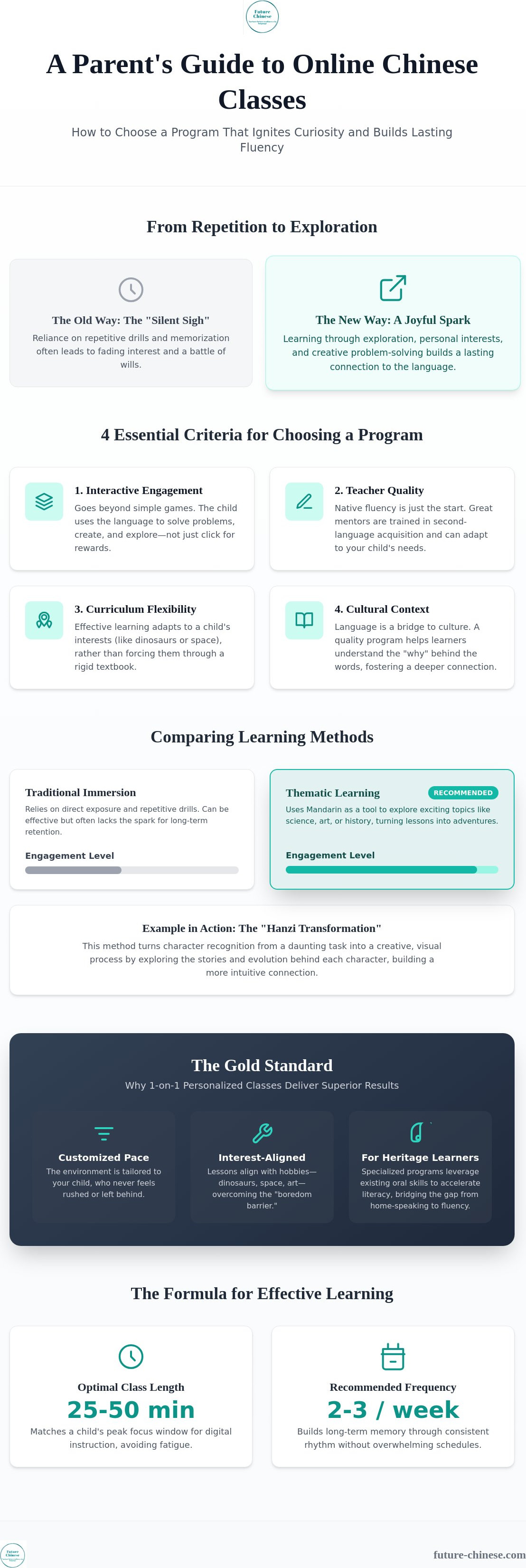
Choosing the right educational path for your child in 2026 requires looking beyond flashy marketing. It's about finding a program that views your child as a unique explorer rather than just another student in a digital queue. As you compare different online chinese classes for kids, focus on these four pillars to ensure the investment leads to genuine fluency and joy.
Interactive Engagement: For today's digital natives, simple game-like elements are the baseline, not the goal. True engagement happens when a child uses the language to solve problems or create something new, rather than just clicking buttons for digital stickers.
Teacher Quality: Being a native speaker is only the starting point. The best mentors are trained in the complex process of learning a second language. They understand how to pivot their teaching style when a child feels frustrated or uninspired.
Curriculum Flexibility: Does the program force your child to follow a rigid textbook, or does the content adapt to their interests? Learning is most effective when it mirrors a child’s natural curiosity about the world.
Cultural Context: Language doesn't exist in a vacuum. A high-quality program builds a bridge to cultural heritage, helping learners understand the "why" behind the words they speak.
The Heritage Learner Advantage
Heritage learners often live in a unique middle ground. They might understand Mandarin spoken at home but struggle when asked to read or write. Standard beginner courses often feel too slow, while advanced classes might be overwhelming. Specialized programs for Chinese for heritage learners are essential because they leverage existing oral skills to accelerate literacy. This approach turns "home-speaking" into a professional-grade asset for their future.
Class Length and Frequency
Science tells us that a child's peak focus window during digital instruction usually falls between 25 and 50 minutes. Shorter sessions often end just as the child is getting "warmed up," while longer ones can lead to mental fatigue. To see measurable progress in online chinese classes for kids, aim for a frequency of two to three sessions per week. This consistent rhythm builds long-term memory without overwhelming your family's busy schedule.
From Immersion to Thematic Learning: Comparing Methods
Traditional language learning often relies on standard immersion, where students learn through direct exposure and repetitive drills. While this method has its place, it often lacks the emotional spark needed for long-term retention. In 2026, the shift toward thematic learning has transformed how we approach online chinese classes for kids. Instead of treating Mandarin as a dry subject to be studied, thematic learning uses the language as a tool to explore science, art, or history, making every session feel like a new adventure.
This interest-based approach creates a much higher level of emotional engagement than traditional flashcards. When a child is genuinely curious about a topic, their brain becomes more receptive to new information. For instance, our "Hanzi Transformation" (漢字變變變) method turns the daunting task of character recognition into a creative, visual process. By understanding the evolution and stories behind characters, kids build a deeper, more intuitive connection to the written language.
This artistic approach is especially effective for children who enjoy visual expression; for example, a child taking an online face painting course can use their existing interest in patterns and colors to better grasp the structure and flow of Chinese radicals.
The Power of Chinese Science Classes
STEM activities are particularly effective because they encourage kids to "forget" they are actually in a language lesson. Participating in a Chinese science class for kids allows learners to acquire complex technical vocabulary naturally by applying it to hands-on experiments and observations. When they are busy predicting the outcome of a chemical reaction or building a model, the Mandarin terms for "hypothesis" or "gravity" become practical tools rather than just words on a list.
Overcoming the "Boredom Barrier"
The primary reason kids quit language programs isn't difficulty; it's a lack of real-world relevance. Parents often have common questions about bilingual development, wondering how to maintain interest when a child feels disconnected from the material. We solve this by aligning our 1-on-1 sessions with your child's existing hobbies, whether that's dinosaurs, space, or digital art. If your child is excited about the topic, the language follows naturally. You might consider exploring our 1-on-1 Customized Lesson options to see how we can tailor a curriculum specifically to your child's passions.
Why 1-on-1 Personalized Classes are the Gold Standard
While group settings offer social interaction, 1-on-1 online chinese classes for kids provide a level of precision that simply can't be matched. Every minute is dedicated to your child's specific needs, allowing them to progress at an individualized pace. There’s no waiting for other students to catch up or feeling rushed by a group that’s moving too fast. This focused attention ensures that every lesson is efficient and deeply impactful.
Personalization goes beyond just the speed of the lesson. It involves integrating your child’s world into the curriculum. Whether it's a favorite toy, a beloved storybook, or a passion for martial arts like those taught at Flinn Taekwondo Academy, our instructors weave these elements into the live session. This creates a safe environment where children feel the confidence to make mistakes and speak freely. Unlike group apps that often miss subtle nuances, 1-on-1 sessions provide direct, real-time feedback on pronunciation and grammar, preventing bad habits from taking root.
Future Chinese: Your Creative Mentor
At Future Chinese, we see ourselves as more than just a platform; we are your child's creative mentor. Our instructors provide personalized 1-on-1 guidance that adapts to each learner’s unique personality. We use specialized tracks like "Little Scientist" to spark curiosity through STEM and "Hanzi Transformation" to make literacy feel like an art project. For older students ready to bridge the gap toward more complex communication, our Mandarin speaking course helps them master real-world conversation with confidence and professional poise.
Getting Started: The Trial Lesson
The best way to evaluate online chinese classes for kids is through a trial lesson. During this first session, look closely at the rapport between the teacher and your child. Does the instructor listen and adapt? Is the platform stable and easy to use? A successful trial should leave your child feeling excited rather than exhausted. As you begin, set realistic goals for the first three months, such as recognizing basic radicals or comfortably introducing themselves. Consistency and a supportive mentor will make these milestones feel like natural achievements rather than chores.
Empower Your Child's Linguistic Journey in 2026
Choosing the right educational path doesn't have to be a struggle for your family. We've explored how shifting from repetitive drills to thematic learning can ignite a child's passion for Mandarin. By focusing on 1-on-1 personalization and interest-based subjects like STEM, you provide your child with a safe space to grow and speak freely. Selecting the best online chinese classes for kids is ultimately about finding a mentor who understands your child’s unique rhythm, especially for heritage and global learners bridging the gap to literacy.
Our Little Scientist and Hanzi Transformation tracks are designed to turn language acquisition into a joyful exploration. We invite you to book a trial 1-on-1 personalized lesson for your child today and see how our experienced instructors can tailor every session to your child's favorite stories and hobbies. Let's work together to build their confidence and create a lasting connection to the Chinese language that they'll carry with them for a lifetime.
Frequently Asked Questions
How do I know if my child is ready for online Chinese classes?
Readiness depends more on your child’s ability to engage with a screen than a specific age. Most children are ready for online chinese classes for kids between the ages of four and five, as this is when they can typically follow simple instructions and maintain focus for 25 minutes. If your child enjoys interactive stories or digital games, they likely have the digital comfort needed to start their linguistic journey with a creative mentor.
What is the difference between Mandarin and Chinese for kids?
Mandarin is the specific spoken dialect and official standard taught in most online chinese classes for kids, while "Chinese" is a broad umbrella term for many dialects. When you enroll your child in a program, you're almost always choosing Mandarin because it's the most widely spoken version used in global education and business. Focusing on Mandarin ensures your child learns the standard pronunciation and simplified or traditional characters used internationally.
Can my child learn Chinese if we don’t speak it at home?
Your child can absolutely master Mandarin even if you don't speak a word of it yourself. Success in a non-speaking household relies on consistent exposure and high-quality instruction that mimics natural acquisition. A personalized 1-on-1 environment provides the immersion they need. By connecting the language to their existing interests, like science or art, we help them build an intuitive understanding that doesn't require parental translation.
How long does it take for a child to become fluent in Mandarin online?
Achieving conversational fluency typically takes two to three years of consistent study, though you'll see measurable progress in much less time. Most students begin recognizing basic characters and using simple sentences within the first three to six months. The timeline varies based on lesson frequency; attending two or three sessions per week is the ideal rhythm to ensure long-term retention without causing burnout for your child.


Comments