

The Best Way to Learn Mandarin as an Adult in 2026: A Strategic Guide
- Future Chinese
- Jul 19
- 7 min read

Most adults start their Mandarin journey with a colorful app and a dream, yet the reality is that reaching professional proficiency takes roughly 2,200 hours of focused effort. It's a daunting figure that makes many feel defeated before they even master their first few tones. You likely recognize the frustration of being stuck on a plateau where you can recognize characters on a screen but freeze when it's time to actually speak. If you're juggling a career, finding the best way to learn mandarin as an adult shouldn't feel like taking on a second full-time job.
The good news is that you don't need to spend years drill-testing flashcards to see real results. This guide promises to show you how to achieve conversational fluency through interactive, personalized methods that bypass the typical "app trap." We'll explore a clear roadmap for 2026, including how to handle the new HSK 3.0 standards and why 1-on-1 guidance is the key to speaking with confidence. Get ready to transform your learning from a chore into an inspiring journey of growth and connection.
Table of Contents
Why Adult Mandarin Learning Requires a Different Strategy in 2026
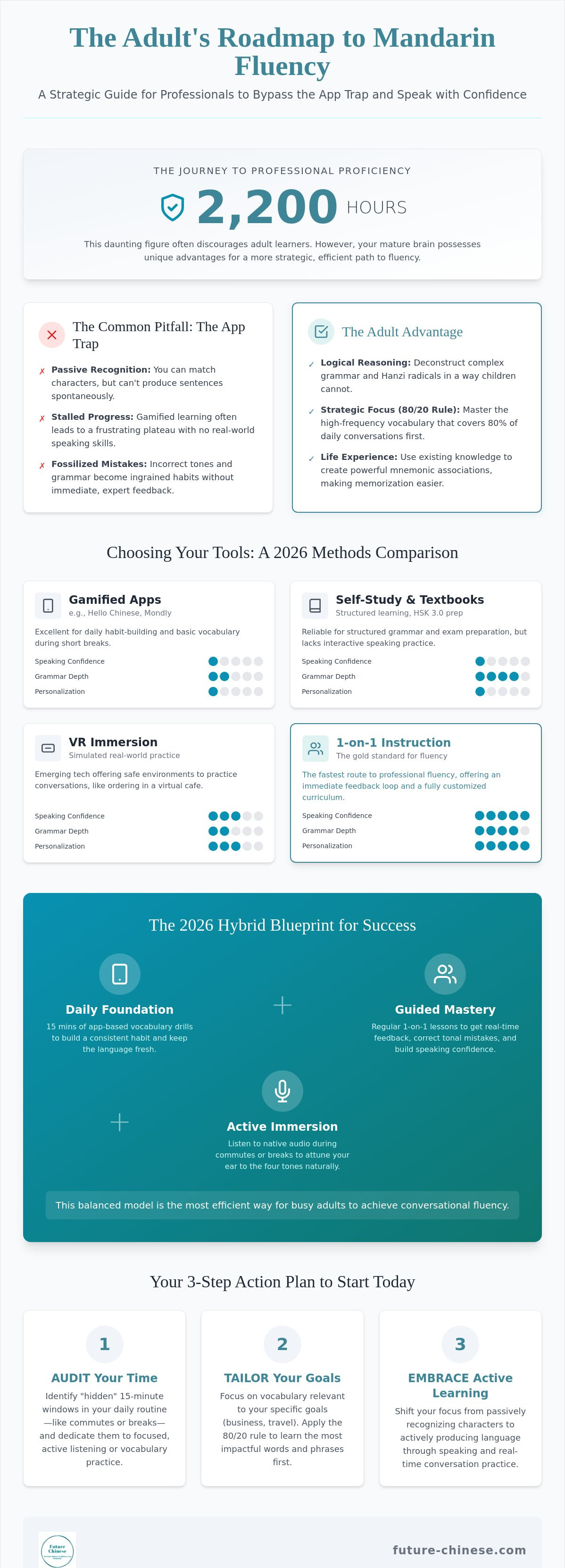
Many people believe that learning a new language is a superpower reserved for children. In reality, your adult brain possesses unique strengths that make the best way to learn mandarin as an adult far more strategic than the immersive "play" method kids use. While children absorb sounds through sheer exposure, you have the ability to use complex logic, pattern recognition, and life experience to deconstruct the language. By applying the 80/20 rule, you can focus on high-frequency vocabulary that accounts for 80% of daily conversation. This allows you to reach functional fluency much faster than a toddler would. This strategic approach is essential given the global rise in Mandarin learning, which has led to more sophisticated, adult-centric teaching methods that respect your intellect and your time.
Overcoming the 'Age Myth' in Language Acquisition
Scientific research confirms that neuroplasticity doesn't disappear; it simply changes. While you might not mimic sounds as effortlessly as a six-year-old, your capacity for active recall and mnemonic association is superior. Adults can master Hanzi by understanding their etymology and radical structures, turning abstract strokes into logical stories. This cognitive maturity allows you to build a sturdy foundation in weeks that might take a child months to grasp. You aren't "too old" to learn; you're simply better equipped to learn systematically.
The Pitfalls of Passive Learning: Why Apps Aren't Enough
Relying solely on gamified apps often leads to the "App Plateau." You might feel productive while matching icons to pinyin, but this passive recognition rarely translates into a business meeting or a street conversation. To truly bridge the gap, you need interactive mandarin lessons that force your brain to produce language in real-time. This active output builds the neural pathways necessary for spontaneous speech. It's about moving from being a spectator to a participant in the language.
Integrating study into a 9-to-5 schedule requires precision rather than persistence. Instead of marathon sessions, successful adult learners use "time-blocking" to find 15-minute windows for active listening. This is the secret to breaking the "tonal barrier." By listening to native speech patterns during your commute, your ear becomes attuned to the four tones without the pressure of a classroom. When you combine this with high-frequency vocabulary, you'll find that speaking Mandarin is no longer a distant dream, but a manageable daily habit.
The Best Ways to Learn Mandarin: A 2026 Roundup of Methods
Choosing the right path in 2026 means navigating a sea of high-tech tools and traditional techniques. While the best way to learn mandarin as an adult often involves a blend of resources, each method serves a specific purpose in your journey. Gamified apps like Hello Chinese or Mondly are fantastic for maintaining a daily "streak" and building basic vocabulary during your morning commute. However, they often lack the depth needed for complex grammar. For those focused on the new HSK 3.0 standards, traditional textbooks and self-study remain reliable for structured exam preparation. Emerging VR technologies now offer simulated immersion, allowing you to practice ordering tea in a virtual Beijing cafe from your living room. Yet, even with these advances, live online classes remain the gold standard for developing true mandarin speaking confidence.
Comparing Self-Study vs. Professional Instruction
DIY learning is undeniably cost-effective, but it carries a hidden risk: the fossilization of tonal mistakes. Without real-time correction, you might spend months practicing a phrase incorrectly, making it harder to unlearn later. Professional guidance provides an immediate feedback loop that self-study simply can't match. This is why personalized chinese lessons are the fastest route to professional-level fluency. They adapt to your specific industry jargon and personal pace, ensuring every minute spent is relevant to your goals. If you're looking for a tailored experience, exploring a 1-on-1 Customized Lesson can help bridge the gap between "knowing" and "speaking."
The Hybrid Approach: The Most Efficient 2026 Model
Efficiency in 2026 is about balance. The best way to learn mandarin as an adult today is a hybrid model that maximizes your time. Aim for 15 minutes of app-based vocabulary drills daily to keep the language fresh, combined with two weekly live 1-on-1 sessions for deep practice. You can also use AI tools as a "tutor assistant" to generate practice sentences or check your writing, but save the nuance of conversation for a human mentor. According to Foreign Service Institute language learning data, the road to proficiency is long, but this focused, multi-channel approach ensures you don't waste a single hour on your way to fluency.
Your 3-Step Action Plan for Mandarin Fluency
Achieving fluency isn't about luck; it's about a well-executed plan. If you want to find the best way to learn mandarin as an adult, you must move beyond scattered study sessions and embrace a three-step strategic approach. First, define your "Why." Whether you're aiming for a promotion in international business or reconnecting with family heritage, your specific motivation should dictate your vocabulary focus. Second, audit your daily schedule to find "hidden" pockets of time. You'll be surprised how much you can learn through podcasts during a commute or while doing household chores. Finally, book a trial session with a professional. Immediate feedback on your pronunciation prevents bad habits from taking root, ensuring your foundation is solid from day one.
Measuring your growth is equally vital for staying motivated. Most successful learners track their progress from "Beginner" to "Intermediate" using the CEFR framework. This system provides clear benchmarks for your abilities, such as the transition from basic survival phrases to participating in complex discussions. This structured visibility turns an abstract goal into a series of reachable milestones, giving you a sense of accomplishment as you climb each level.
Building a Sustainable Daily Routine
Consistency trumps intensity every time. The "1% Better" rule suggests that just 10 minutes of daily engagement is more effective than a three-hour weekend cram session because it keeps your neural pathways active. You can enhance this by creating a "Mandarin Environment" at home. Surround yourself with authentic media, listen to Chinese music, or label household items in Hanzi. These small, sensory experiences make the language feel like a natural part of your life rather than a distant academic subject.
The Logical Choice: Joining a Mandarin Speaking Course
While self-study has its place, joining a structured mandarin speaking course removes the exhausting guesswork from your journey. A professional curriculum, much like a modern university curriculum, provides the necessary scaffolding to move from simple phrases to complex ideas. Beyond grammar, these courses offer essential cultural context. Understanding the social nuances behind certain expressions helps you speak naturally, allowing you to avoid the awkwardness of literal "textbook" translations and build genuine connections with native speakers.
Unlock Your Future with Strategic Mandarin Learning
Mastering a new language as an adult isn't about working harder; it's about working smarter. By leveraging your logical strengths and focusing on high-frequency communication, you can bypass the traditional hurdles that stop most learners. We've explored how a strategic hybrid model and a clear, personal "Why" serve as the foundation for success. It's clear that the best way to learn mandarin as an adult is to move beyond solitary apps and engage in real, dynamic conversations that build lasting confidence.
At Future Chinese, we understand the unique challenges of a busy schedule. Our native instructors specialize in adult pedagogy, offering customized learning plans that fit into your lifestyle. Whether you're in a different time zone or balancing a demanding career, our flexible scheduling ensures your progress never stalls. Ready to start speaking? Book your personalized 1-on-1 Mandarin trial lesson today!
Your journey to fluency is a path of discovery and growth. With the right support and a manageable roadmap, those tonal mysteries and complex characters will soon become second nature. We're excited to be your partner in this rewarding adventure and can't wait to see you succeed.
Frequently Asked Questions
Is it harder for adults to learn Mandarin than other languages?
Mandarin is classified as a Category IV language, meaning it requires more time to master than Romance languages like Spanish or French. However, adults often find Chinese grammar surprisingly logical because it lacks complex verb conjugations and gendered nouns. While the tonal system is a new challenge, your analytical skills and life experience actually make the best way to learn mandarin as an adult much more efficient than the passive immersion children use.
How many hours a week should an adult study to become fluent in Chinese?
Reaching professional proficiency typically requires around 2,200 hours of total study according to benchmark data. For a busy professional, committing 5 to 10 hours per week is a sustainable pace that ensures steady progress without causing burnout. This time should be a balanced mix of active 1-on-1 instruction and passive listening during your daily routine to keep the language fresh in your mind.
Do I need to learn how to write characters to speak Mandarin?
You don't need to master the art of hand-writing thousands of Hanzi to become a fluent speaker. Many adults focus on Pinyin for pronunciation and character recognition for digital typing, which is sufficient for most business and travel needs. While understanding the logic of characters can help you navigate a Chinese city or read a menu, you can certainly achieve high-level conversational fluency without spending years on traditional calligraphy.
What is the best online platform for 1-on-1 Mandarin tutoring in 2026?
The most effective platform is one that moves away from generic lessons and offers a 1-on-1 Customized Lesson tailored to your professional or personal goals. Future Chinese provides a specialized Adult Mandarin Course that prioritizes real-world communication and cultural nuance. Our native instructors use modern adult pedagogy to help you gain confidence quickly, ensuring that every session is a direct step toward your fluency goals.


Comments