

Hanzi Learning for Kids: The Visual Transformation Method to Master Characters
- Future Chinese
- 4 days ago
- 7 min read

What if your child's Chinese homework felt less like a repetitive chore and more like a vibrant puzzle they couldn't wait to solve? For many parents, hanzi learning for kids is synonymous with piles of practice sheets and the high frustration of seeing characters forgotten by the next morning. It's exhausting to watch your little one struggle with what looks like a series of random lines, especially when the cultural magic of the language gets lost in the grind.
We believe that learning should be an adventure, not a test of endurance. In this guide, you'll discover how to turn frustrating memorization into a creative visual journey that helps your child read and write Chinese naturally. We'll show you how the logic of pictograms can help your child master over 100 high-frequency characters while turning their curiosity into self-motivated learning. By the end, you'll have a clear roadmap to transform those "random lines" into meaningful stories your child will love to tell.
Table of Contents
Why Traditional Hanzi Learning for Kids Often Fails
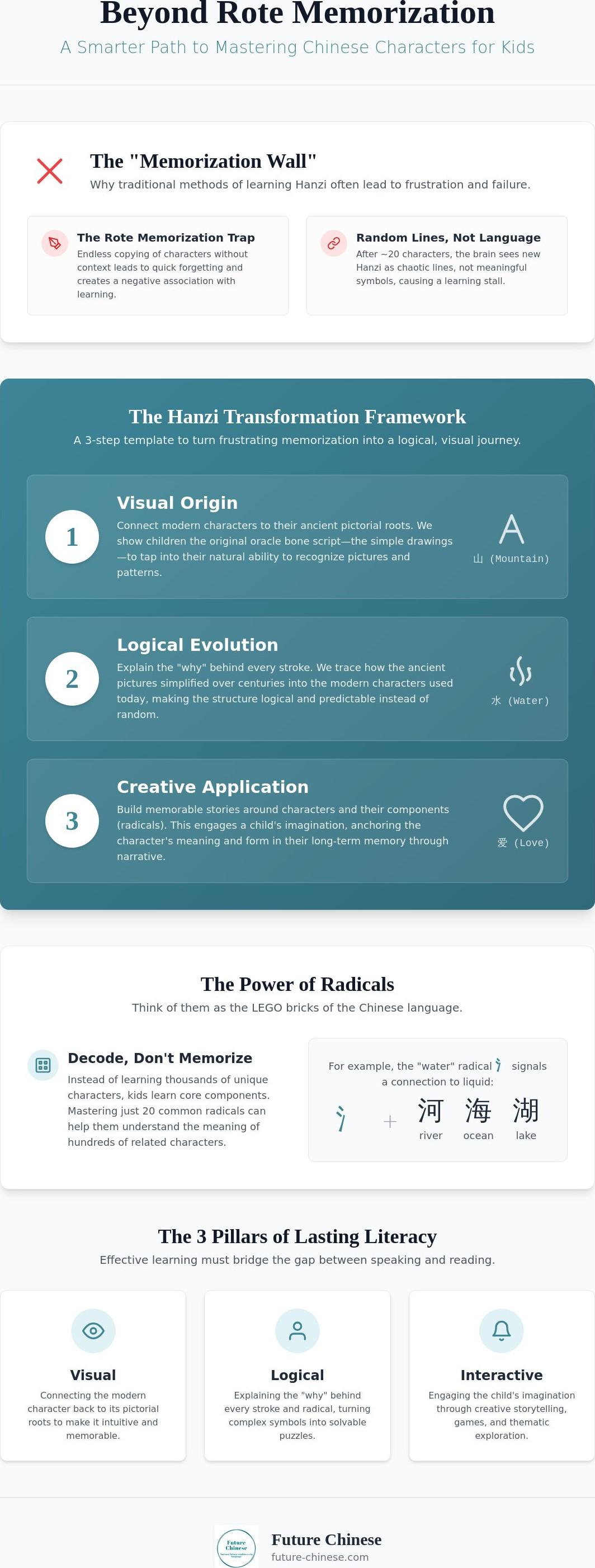
Watching a child stare at a blank page, unable to recall a character they wrote fifty times yesterday, is heartbreaking for any parent. It's a common struggle. This frustration is often the result of the "Memorization Wall." Most children can memorize about 20 characters through sheer willpower. Beyond that point, the brain begins to treat new Hanzi as a chaotic jumble of lines rather than a language. The brain simply rebels. This is especially true for families living in non-Chinese environments where the "forgetting curve" hits harder; without daily environmental reinforcement, characters fade almost as quickly as they are learned.
The core issue lies in traditional methods of teaching Chinese characters that prioritize repetitive copying. While this might work for short-term test prep, it fails to build a foundation of radical logic. Hanzi learning for kids shouldn't be a test of endurance. It should be an exploration of how the language is built. We believe that for a child to truly master literacy, the process must be visual, logical, and deeply interactive.
The Rote Memorization Trap
Why do abstract symbols disappear from memory so quickly? Our brains are naturally wired to process and retain vivid imagery, not abstract, geometric lines. When we force children to write characters repeatedly without context, we aren't just making it hard; we're often creating a lasting negative association with the language. Traditional weekend schools that focus on endless worksheets can make Chinese feel like a chore rather than a gift. This creates a psychological barrier that is much harder to overcome than the characters themselves.
Bridging Speaking and Literacy
Speaking isn't reading. Many parents of Chinese for heritage learners face a unique challenge: their children speak fluently but are functionally illiterate when faced with a menu or a book. This gap happens because speaking is learned through immersion, while reading requires a systematic understanding of the character's visual evolution. Effective hanzi learning for kids must bridge this gap by focusing on three pillars:
Visual: Connecting the modern character back to its pictorial roots.
Logical: Explaining the "why" behind every stroke and radical.
Interactive: Engaging the child's imagination through creative storytelling.
The Hanzi Transformation Framework: A 3-Step Template
To break through the memorization wall, we need a system that mimics how the human brain actually learns. We define Hanzi Transformation as a method that turns characters into logical puzzles. This shift in perspective changes everything for a young learner. Instead of seeing a chaotic series of strokes, they begin to see a story with a beginning, middle, and end. This framework moves through three distinct phases to ensure deep retention and genuine understanding.
Step 1 begins with the Visual Origin. By showing children the ancient oracle bone script, we tap into their natural ability to recognize patterns and pictures. Step 2 focuses on Logical Evolution, demonstrating exactly how those ancient drawings simplified into the modern script we see today. Finally, Step 3 uses Creative Application to build memorable stories around radicals. This three-step template ensures that hanzi learning for kids becomes a process of discovery rather than a chore. It's a way to make the invisible logic of the language visible to a child's curious eyes.
From Oracle Bones to Modern Script
Think about the character for "Mountain" (山). In its earliest form, it was a literal drawing of three jagged peaks. Or consider "Water" (水), which began as a curving line representing a flowing stream. When kids see these links, the characters stop being abstract and start being "drawings." This approach aligns with research on effective character learning that emphasizes how visual associations help overcome the forgetting curve. This template isn't just for simple nouns; it can be applied to complex ideograms, helping children decode abstract concepts through their visual history.
The Power of Radicals as Building Blocks
Radicals are like the LEGO bricks of the Chinese language. Instead of learning thousands of unique symbols, your child only needs to master the core components. For example, once a child understands the "water" radical (氵), they can immediately guess that characters like "ocean" (海) or "river" (河) are related to liquids. Mastering just 20 common radicals can unlock the meaning of hundreds of characters. This systematic approach is a cornerstone of our Hanzi Transformation (漢字變變變) course, where we help students build their literacy brick by brick. Hanzi learning for kids is most successful when we empower them with logic, not just lists.
Choosing the Right Hanzi Learning Program for Your Child
Picking the right path for hanzi learning for kids can feel overwhelming with so many digital resources available. Just as you might explore Commercial and Residential Landscaping and Construction Service Fees to find experienced professionals like Green Earth, LC for a home project, choosing a language program requires evaluating the level of expertise and precision provided. While free videos or pre-recorded apps offer a quick start, they often miss the most critical element of writing: real-time feedback. Writing Chinese is a physical skill that requires precision; without a teacher to guide a child's hand and correct stroke order, bad habits can set in that are difficult to unlearn later.
A truly effective program goes beyond the screen to offer personalized Chinese lessons that adapt to your child's unique pace and interests. We've found that interest stays highest when characters aren't taught in isolation. By integrating Hanzi into our Little Scientist course, children learn the characters for "gravity" or "magnet" while conducting hands-on experiments. This "Immersive STEM" approach ensures they aren't just memorizing symbols; they're using them to explore the world around them.
The Future Chinese Advantage
Our specialized 漢字變變變 (Hanzi Transformation) course is designed to bridge the gap between recognizing a character and using it in real-world communication. We don't just want kids to pass a test. We want them to develop the cultural competence to navigate a Chinese-speaking environment with ease. By focusing on how characters evolve and relate to one another, we turn a daunting task into a series of achievable, exciting milestones that build genuine literacy. Hanzi learning for kids becomes a natural extension of their curiosity.
What to Look for in a Mandarin Tutor
Choosing a guide for your child's language journey is a significant decision. Look for a tutor who brings more than just native fluency to the table. A great instructor needs a specific set of skills to be effective:
Proven experience working with children's unique attention spans and energy levels.
A "growth mindset" approach that praises effort and creative problem-solving over perfection.
The ability to provide constant, warm encouragement to build mandarin speaking confidence.
Our instructors act as creative partners and mentors. They ensure that every lesson feels safe, supportive, and full of "aha!" moments that keep your child coming back for more.
Empower Your Child’s Journey to Literacy Today
Transitioning from frustrating memorization to a world of visual discovery is the most powerful gift you can give your young learner. We've explored how traditional rote practice often leads to a "Memorization Wall" and why a logical, three-step framework is the key to unlocking long-term retention. By connecting characters to their ancient roots and using radicals as building blocks, hanzi learning for kids becomes an engaging puzzle rather than a repetitive chore.
Choosing a program that offers personalized 1-on-1 feedback ensures your child masters every stroke with confidence. Our curriculum is designed by experts in child language acquisition and is trusted by a global community of happy parents and fluent kids. Ready to see the transformation for yourself? Book a Free Trial Lesson for the Hanzi Transformation Course Today! We're excited to help your child explore the magic of Chinese characters and build a lifelong love for learning that lasts.
Common Questions About Hanzi Learning
How many Hanzi should my child learn per week?
Most beginners find that learning 3 to 5 characters per week is the perfect pace for effective hanzi learning for kids. It's much better to master a few characters deeply than to rush through a long list and forget them by the weekend. This steady rhythm allows your child to explore the visual story behind each character without feeling overwhelmed. As they become more familiar with radicals, you might find they naturally want to speed up to 10 characters per week.
Is it better to learn Simplified or Traditional characters first?
The choice between Simplified and Traditional characters depends entirely on your family's specific goals and regional connections. Simplified characters are the standard in mainland China and Singapore, while Traditional characters are used in Taiwan and Hong Kong. Many parents find that learning Traditional first provides a deeper understanding of the character's original visual logic. The most important thing is consistency; once you pick a system, stick with it to avoid confusing your child during their early stages.
Can my child learn Hanzi if I don’t speak Chinese at home?
Your child can absolutely succeed in hanzi learning for kids even if you aren't a Chinese speaker yourself. Modern online programs provide the structure and professional guidance needed to bridge the gap between school and home. Our instructors act as the primary language models, while you play the vital role of the encouraging cheerleader. Creating a "language corner" at home with visual labels and storybooks can help reinforce what they learn in class without requiring you to be fluent.
At what age should kids start learning to write Chinese characters?
Most children develop the necessary fine motor skills to begin learning to write characters around age 5 or 6. Before this age, it's wonderful to focus on character recognition through play and drawing the "pictures" that represent the ancient oracle bone scripts. Starting at this stage helps them build a positive relationship with the language before they tackle formal stroke order. We always encourage a gentle start that focuses on the joy of discovery rather than the pressure of perfect penmanship.


Comments