

How to Learn Chinese Characters Online: The 2026 Visual Mastery Checklist
- Future Chinese
- 3 days ago
- 8 min read

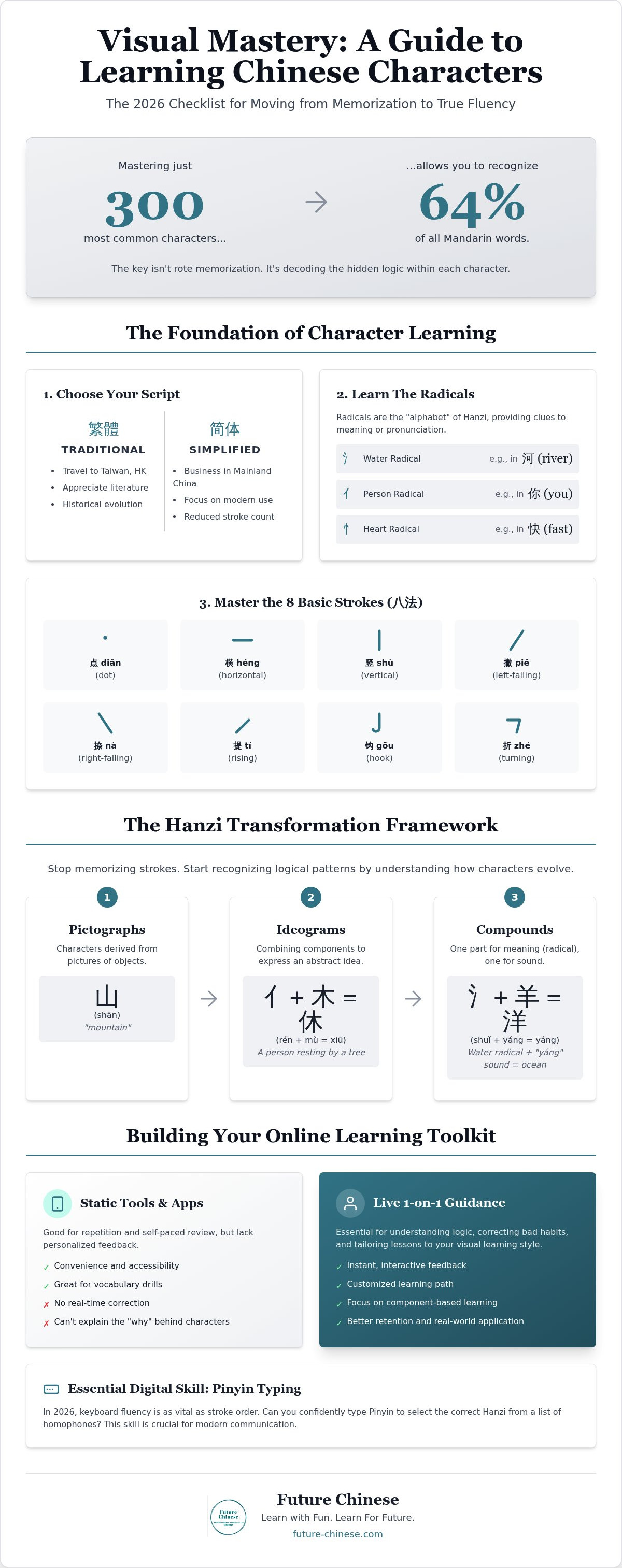
Did you know that mastering just the 300 most common Chinese characters allows you to recognize 64% of all Mandarin words? While that sounds like a shortcut, many students still find themselves trapped in a cycle of rote memorization, only to forget every stroke by the next morning. If you've ever felt overwhelmed by the sheer volume of Hanzi or frustrated when you mix up two similar looking characters, it's not a lack of talent. It's usually a lack of a visual system. Understanding how to learn chinese characters online effectively requires shifting your focus from repetitive drills to decoding the hidden logic within each character.
We understand how discouraging it feels to see a page of text and only see a blur of ink. That's why we've designed this 2026 visual mastery checklist to help you move from memorization to true fluency. You'll learn how to break down complex Hanzi into their core components and use the updated HSK 3.1 standards to prioritize your progress. By the end of this guide, you'll have a clear framework to stop guessing and start reading real world signs and texts with genuine confidence. Let's transform those intimidating symbols into a language you can finally see.
Table of Contents
The Foundation of Character Learning: Essential Checklist for Beginners
Learning Hanzi isn't about memorizing thousands of disconnected pictures. It's about building a solid structural foundation. By understanding the history of Chinese characters, you realize they are a logical system of components rather than random scribbles. When you're figuring out how to learn chinese characters online, starting with the right building blocks saves you months of frustration. You don't need to be an artist; you just need to be a pattern seeker.
Choosing Your Script: Traditional or Simplified?
Before you pick up a digital pen, you must decide which script fits your future. Traditional characters are used in Taiwan and Hong Kong, preserving the intricate details of their historical evolution. Simplified characters, used in Mainland China and Singapore, were designed to increase literacy rates by reducing stroke counts. Use this checklist to decide:
Are you planning to learn Mandarin Chinese online for travel to Taiwan or Hong Kong? (Choose Traditional)
Are you focusing on business in Mainland China or Singapore? (Choose Simplified)
Do you want to appreciate classical literature and calligraphy? (Choose Traditional)
Don't worry about being "locked in." Starting with one doesn't prevent you from learning the other later. Many students find that once they master the logic of one script, the other becomes much easier to recognize through context.
The Radical Advantage
Radicals act as the "alphabet" of Hanzi, providing essential clues to a character's meaning or how it's pronounced. Think of them as the DNA of the language. Instead of copying lines, you'll learn to see the "anatomy" of the character. This approach is much more effective than rote copying because it gives your brain a hook to hang the new information on. Mastery begins with these checks:
Can you identify the 'water' (氵), 'person' (亻), and 'heart' (忄) radicals in a block of text?
Are you connecting the visual character to its Pinyin sound and tone from day one?
Can you distinguish the 8 basic strokes that make up every character?
Connecting the visual shape to Pinyin immediately ensures you don't just "see" the character, but you "hear" it too. This multi-sensory approach is the fastest way to achieve visual fluency online.
Evaluating Visual Learning Methodologies: The Hanzi Transformation Framework
Many learners view characters as static blocks to be copied until they stick. However, the most effective strategies for learning Chinese characters involve seeing them as dynamic transformations. When you explore how to learn chinese characters online, look for programs that use visual mnemonics. These stories turn a cluster of lines into a memorable scene, making the difference between "I think I've seen this" and "I know exactly what this means." This logic moves you from simple pictographs to complex ideograms through clear, manageable steps.
While apps offer convenience, live online Chinese lessons provide the essential interactive feedback that static tools lack. A professional tutor can spot when you're confusing the 'person' radical with the 'knife' radical in real time, correcting your logic before a bad habit takes root. This component-based learning focuses on the parts that make up the whole, which drastically improves your recognition speed. It's much easier to remember three familiar components than twenty individual strokes.
From Pictures to Characters
At Future Chinese, we use the 'Hanzi Transformation' method to guide you through this process. It's a student-centered journey that turns abstract shapes into recognizable objects. Our personalized Chinese lessons help you build a custom path to fluency by focusing on the characters you'll actually use in your daily life. If you're ready to see the logic behind the lines, our 漢字變變變 course provides the perfect framework for visual mastery.
Digital Tools vs. Hand-Writing
In 2026, keyboard fluency is just as vital as stroke order. You must master typing Pinyin to select the correct Hanzi quickly from a list of homophones. Use this checklist to evaluate your digital skills:
Can you distinguish between similar-looking characters in a typing menu?
Do you know how to type Pinyin for characters with the 'ü' vowel?
Are you using Spaced Repetition Systems (SRS) for daily vocabulary maintenance?
While digital tools are great for retention, don't abandon the physical pen entirely. Writing by hand reinforces the "muscle memory" of the character's structure. Balancing how to learn chinese characters online with occasional paper-and-pen practice creates the strongest mental connection.
Building Your Online Character Learning Toolkit: Tools and Consistency Checklist
Imagine waking up and actually looking forward to your character review. That's the power of a well curated toolkit. When researching how to learn chinese characters online, many people get stuck using static apps that lack cultural depth. While digital flashcards have their place, they can't replace the nuanced guidance of a mentor who understands the specific hurdles of Hanzi. A managed platform ensures your character progress aligns with your speaking skills, preventing the common "literacy gap" that many self taught students face.
Vetting Your Online Instruction
Choosing the right guide is the most critical step in your journey. Use this checklist for evaluating 1 on 1 Mandarin tutoring to ensure your instructor specializes in character pedagogy rather than just conversation:
Does the tutor use interactive whiteboards for real time character practice and stroke order correction?
Can they explain the visual evolution of a character to make it more memorable?
Ask the tutor: "How do you help students distinguish between similar characters like 牛 (niú) and 午 (wǔ)?"
An expert online Mandarin tutor provides the immediate correction needed to prevent visual confusion before it becomes a habit.
Creating a Character-Rich Environment
Consistency is the secret ingredient to mastery. For those with an online Mandarin class flexible schedule, integrating characters into daily life makes learning feel like an adventure rather than a chore. Try setting a realistic "Character per Day" goal. Mastering just three new Hanzi daily adds up to over 1,000 in a single year. To keep your brain engaged, seek out "comprehensible input" by reading simple online texts that use characters you've already studied in class.
Our specialized programs, such as the STEM-integrated "Little Scientist" course, take this a step further by teaching characters through hands on experiments. This method ensures that how to learn chinese characters online becomes a natural extension of your curiosity about the world. By moving beyond boring drills and into practical application, you'll find that your confidence grows alongside your vocabulary. At Future Chinese, we're here to accompany you on this creative path toward visual mastery.
Unlock Your Visual Fluency Today
Mastering Chinese characters is no longer an exercise in frustration or endless repetition. By focusing on the structural logic of radicals and the power of visual storytelling, you've already taken the first step toward true literacy. We've explored how building a foundation in character anatomy and choosing a consistent, digital friendly toolkit can transform your learning experience. Finding the most effective way for how to learn chinese characters online is ultimately about connecting with a system that respects your individual learning style and pace.
At Future Chinese, we believe every student deserves a path that sparks curiosity. Whether you're exploring our specialized Hanzi Transformation curriculum or engaging with our STEM-integrated Little Scientist track, our goal is to make every lesson an adventure. Our personalized 1-on-1 coaching ensures that you never have to decode the logic of Hanzi alone. If you're ready to stop memorizing and start truly seeing the language, we're here to guide you. Book a 1-on-1 session to master Hanzi with a Future Chinese expert and begin your journey toward confidence and clarity. The world of Hanzi is waiting for you to discover its secrets, and we can't wait to see you thrive.
Frequently Asked Questions
Is it better to learn to speak Mandarin before learning characters?
You should ideally learn to speak and read simultaneously to build the strongest mental associations. While some students prefer a speaking-first approach, delaying characters often creates a literacy gap that becomes harder to bridge as you reach intermediate levels. Learning Hanzi early helps you distinguish between homophones that sound identical in conversation but have completely different meanings and visual forms.
How many Chinese characters do I need to know to read a newspaper?
You generally need to master about 2,000 to 3,000 characters to read a standard newspaper with 95% comprehension. However, you don't need to wait years to start reading. The most common 300 characters make up roughly 64% of all Mandarin words. By prioritizing these high frequency characters, you can begin to understand the general gist of news headlines and digital content much sooner than you might expect.
Should I learn traditional or simplified characters first in 2026?
Your choice should depend entirely on your geographical and professional goals. If you're planning to travel to Taiwan or Hong Kong, traditional characters are essential. For business in Mainland China or Singapore, simplified characters are the standard. In 2026, the HSK 3.1 standards prioritize practical usage, so it's best to choose the script you'll see most often in your daily life or work environment.
Can I learn Chinese characters effectively using only free apps?
Free apps are excellent tools for daily review, but they rarely provide the deep structural logic needed for long term mastery. When students research how to learn chinese characters online, they often find that apps rely too heavily on rote repetition. To truly understand character anatomy and avoid mixing up similar looking Hanzi, you'll find that personalized guidance from a tutor is much more effective than an algorithm.
What is the 'Hanzi Transformation' method exactly?
The 'Hanzi Transformation' (漢字變變變) method is a visual framework that turns abstract strokes into recognizable objects and stories. Instead of memorizing lines, you learn to see how characters evolved from simple pictographs into complex ideograms. This creative approach acts as the antidote to boring drills, allowing you to decode the logic of Hanzi through imagination and systematic progress rather than just copying lines.
How do I stop forgetting characters I just learned?
The secret to retention is combining a Spaced Repetition System (SRS) with "comprehensible input" from real world texts. Seeing a character in a news article or a sign reinforces the memory much better than seeing it on a flashcard alone. If you're struggling with how to learn chinese characters online without forgetting them, try connecting each character to a specific visual mnemonic or a STEM experiment to give your brain a stronger hook.


Comments